Meeting the “PMO Challenge”
PMOs began almost a century ago, yet 50–75% of Project Management Offices are shut down within their first three years. HKA is a leader in the design, establishment and resourcing of PMOs — and HKA Tech provides the systems that make them succeed.
A century of practice, yet most PMOs still fail
PMOs in their original form began almost a century ago, with modern-day use emerging in the 1990s. Leading organisations such as the Project Management Institute in the USA and the UK Government have published extensively on the elements of PMO success. Yet 50% to 75% of Project Management Offices (PMOs) fail and are shut down within their first three years.
HKA is a leader in the design, establishment and resourcing of PMOs. HKA Tech provides specialist services in the design and implementation of the systems needed for PMO success.
What is the “PMO Challenge”?
Despite their potential for positive impact — and despite a large body of knowledge about what is needed for a PMO to be successful — PMOs continue to fail, or are closed by organisations who are not seeing the planned benefits being realised. Understanding the reasons for this is the first challenge. The second challenge is ensuring the correct foundations for success.
There is extensive material online published by the two main institutional sources of PMO information:
Project Management Institute (PMI)
The USA-based PMI, with its Project Management Body of Knowledge (PMBOK), specific guides on Portfolio Management and PMOs, resource libraries and a PMO professionals certification program.
PeopleCert (P3O, MSP, PRINCE2)
European-based PeopleCert is the current steward of P3O, MSP and PRINCE2 as developed by the UK Government — P3O remaining a key standard for Portfolios, Programs and Projects, alongside MSP (Managing Successful Programs).
PMOs have also been the subject of extensive research over the years, with informative publications including:
PMI — State of the Modern PMO
The Project Management Institute's review of how PMOs are evolving in practice.
Read the reportWellingtone — State of Project Management 2026
Wellingtone's annual benchmark of project and PMO practice across organisations.
Read the reportGartner — 2025 Strategic Roadmap
Gartner's PMO research team published its 2025 Strategic Roadmap for the PMO, including the shift to an agile, AI-enhanced “Adaptive Project Management Office”.
View on GartnerFrom research in these publications, the known reasons for PMOs failing or being closed because they are not delivering planned benefits include:
- Overly-rigid policies and procedures, perceived as adding an unnecessary layer of bureaucracy that slows projects down rather than helping them succeed.
- PMO management divorced from the realities of day-to-day project management, acting more like a policeman than a facilitator.
- Ineffective change management, including failure to deal with “conservative inertia” and active push-back.
- Ineffective alignment with the organisation's strategic objectives — whether financial, risk-based, environmental, community-based or otherwise.
- Failure to deliver perceived benefits, whether the original core proposition (usually cost / time / scope / risk) or the competing constraints of value, quality and reputation.
- Lack of executive support, with no “champion” of sufficient authority — often compounded by the shortfalls above and a conclusion that the PMO is an unnecessary overhead.
Meeting the challenge
There is no “magic bullet” here. All too often that thinking surfaces and has unplanned consequences. Establishing and operating a PMO requires careful planning and ongoing diligence; and implementing the required systems demands the same. In both cases, time needs to be taken to understand the organisational constraints and carefully address the alignments needed — whether with the organisation's overall culture or with its enterprise systems.
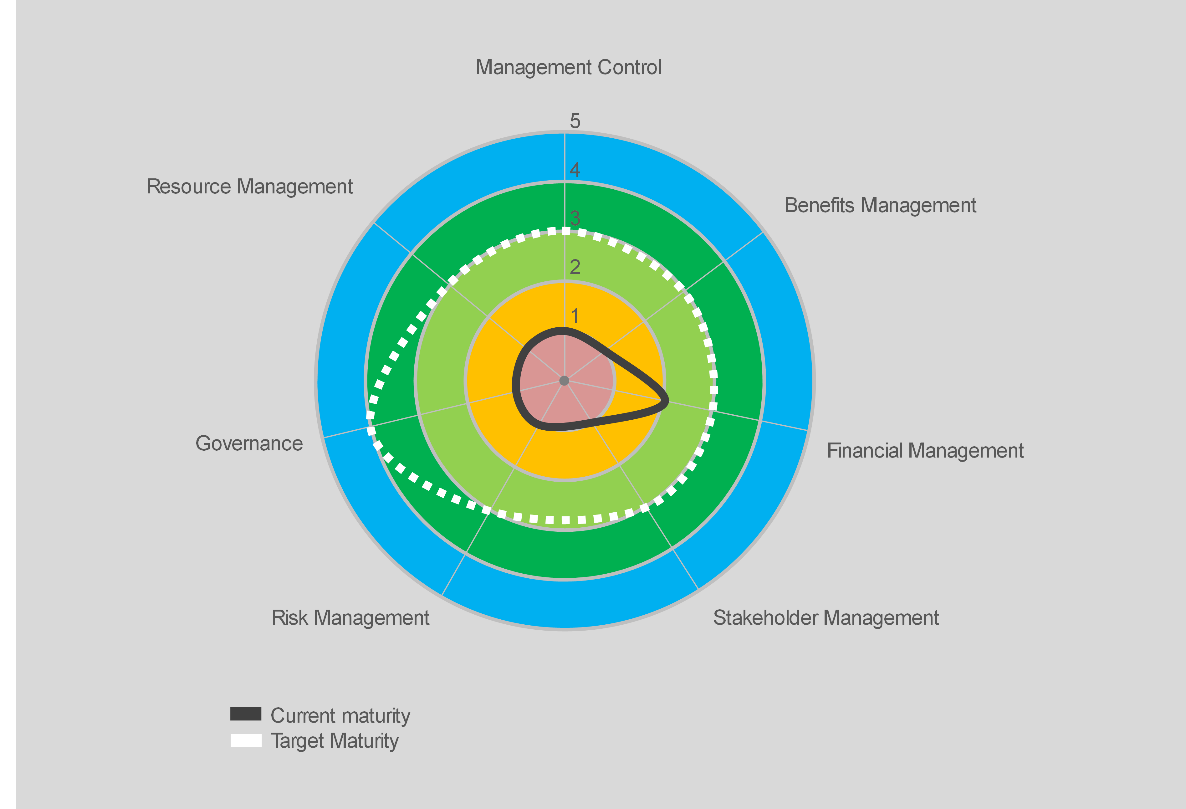
HKA has extensive experience in the design, establishment and resourcing of PMOs for both private sector and government organisations. We have also undertaken maturity assessments of existing PMOs. Through so many implementations — which in some cases have included resourcing the PMO with our own personnel through the critical stages of introducing a new PMO to an organisation — we have developed genuine hands-on experience in meeting and overcoming the traditional challenges. Our PMO Advisory team can provide services across all aspects of PMO establishment, operation and review.
From a systems perspective, HKA Tech has implemented systems for Portfolio, Program and Project Management for both PMOs and for organisations that have not established a PMO. We provide software implementation services aligned to organisational objectives, together with specific HKA tools designed to complement and reinforce the software's out-of-the-box features for whole-of-lifecycle Program and Project Management. This has included reviews of existing PMO systems and the production of roadmaps for future development, including integration with enterprise systems.
One toolkit for the full breadth of PMO operations
One popular tool is the HKA Governance Toolkit. HKA originally developed it for clients with large and complex portfolios and implemented it in a number of environments — including in SharePoint for multi-billion-dollar transport infrastructure projects. Its functionality was refined through use and further tailored for operation within PMWEB from 2015 onwards. The toolkit addresses a range of PMO management requirements with related reporting, including RAID functionality (Risks, Assumptions, Issues and Dependencies) as well as Benefits and Lessons Learned.
Key areas in PMO operations — whether for the PMO's own operations or in providing guidance and support to project teams — include:
Manage & Report
- Governance
- Reporting
- Program / Project Management
- Financial Management (Budgets, Funding, Actuals, Forecasting)
- Schedule Management
- Procurement & Contract Management
Control & Coordinate
- Change Management
- Change Control
- Document Management
- Stakeholder Management
- Resource Management
- Quality Management
- Benefits Management
RAID & Beyond
- Risk Management
- Issue Management
- Dependency Management
- Action Management
- Decision Management
- Deliverables Management
- Lessons Learned
A number of these areas overlap — Quality Management, for example, traditionally includes Deliverables Management, Risk Management, Change Management, Communications / Stakeholder Management and Lessons Learned, all duly documented.
Most of these areas are served by PMWEB's out-of-the-box functionality, as shown elsewhere on this site. HKA's Governance Toolkit is available as an option and includes forms, processes and reports for the management of Risks, Issues, Benefits, Lessons Learned and Decisions. These tools operate in conjunction with PMWEB functionality such as Workflow, Notifications, Document Management, Correspondence and Actions Management.
Building or reviewing a PMO?
From design and establishment through to maturity assessment, our PMO Advisory team helps you put the right foundations in place — before the systems go in.
Risk Management
Standard PMWEB SaaS includes a range of functionality typically used in risk management. The extent of use depends on the client's requirements, some of which may already be delivered by other enterprise systems. PMWEB's flexibility in integrating with third-party systems lets the client select the risk-management functionality that best serves its needs. In addition to specific risk-related functionality, PMWEB also makes available:
- The Microsoft Business Intelligence platform.
- Workflow.
- Communication tools such as notifications, reminders and alerts.
- Document Manager.
- Platform and record tools such as checklists, notes and attachments.
It should be noted that PMWEB does not provide, out-of-the-box, the typical tool used for major risk re-rating exercises — such as on contract award for a major capital works project — where a client may require a function such as Monte Carlo analysis.
Although PMWEB can technically be configured to do this through its build on the Microsoft Business Intelligence platform, clients who require this level of analysis are better served (cost-wise) by a specialist tool such as the Palisade Excel-based @RISK tool. The results of the analysis are then attached to the relevant PMWEB record. Using PMWEB's form builder, a template can capture the Monte Carlo simulation information should the client require it, and the output graphs can be uploaded so they become part of the Monte Carlo Analysis report in PMWEB. Other tools used for Monte Carlo analysis include Primavera Risk Analysis and Deltek Acumen Risk.
Issue Management
Issues is a term used in capital works processes to describe something that has occurred and needs to be addressed. There are many types of issues. In managing technology projects, there can be both issues and bugs:
A bug is a specific issue related to a defect or flaw in the software code or functionality — a technical problem that needs to be fixed by developers. An issue is a broader term encompassing a range of problems, tasks or concerns in a software project, including bugs and other types of requests or challenges.
Products like Jira are set up to manage issues in a structure that includes classification to Jira's standards, such as Epic, Task and Sub-task. Bugs are a classification in the Jira structure, meaning “a problem which impairs or prevents the functions of a product.”
In PMWEB, the HKA Issues Form is usually the tool to capture issues of all types, including bugs. If required, a more specific IT-related form can be developed (by HKA or by the client) using PMWEB's Form Builder. More usually, the Issues Form in the HKA Governance Toolkit is modified for organisations with a significant volume of IT project activity. This can operate independently, through integration with Jira, or the IT team may continue using Jira for their issues and bugs.
Like all PMWEB forms, the Issues Form allows unlimited notes and attachments, can be progressed through workflow, and can include notifications and other triggers specific to client requirements. Reporting is performed using SSRS, allowing the information to be sliced and analysed according to the needs of the viewer or operating department.
Benefits
Benefits are a key consideration in the Planning phase and must be tracked both through project delivery and after completion or handover. Some benefits are not realised for a decade or more after project completion; others are more immediate.
A project may be a success within itself using the traditional three criteria of being on time, to cost and to specification (Scope), yet still be a business failure unless the business outcomes and benefits resulting from the project are successfully achieved and measured. Without a management process to drive project benefits, they may not be realised.
Typically, a Benefits Realisation Plan (BRP) for particular projects is put in place based on a BRP template developed by the client. The BRP recognises the phases and tools needed to monitor and manage benefits.
Phases
Tools
This information is consolidated via the Benefits Form, and that central source is used for both dedicated benefits reporting and for related information in overall program and project dashboards. The form uses multiple tabs and tables for data capture, which can be modified to meet client specifics.
Use of the Benefits Form needs to be coordinated with other client processes, such as Change Management. All too often no one is assigned as Benefits Manager, or they are not involved in change considerations. Rejecting a $100,000 cost increase may seem appropriate without considering benefits — but non-completion of the $100,000 in works could see the planned benefits evaporate.
Lessons Learned
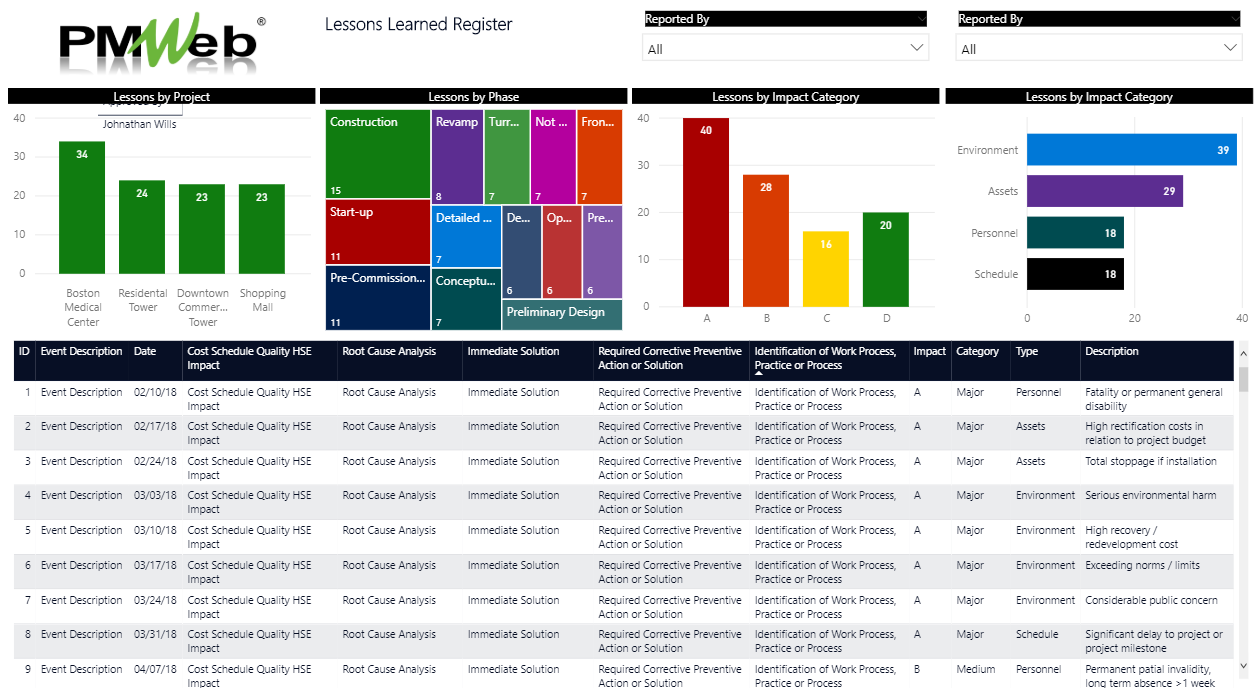
The Lessons Learned Form in the HKA Governance Toolkit is frequently modified to client specifics. Some clients want to capture only the specific lesson, including categorisation of where it should be applied in future. Others require the capture of substantial historical substantiating information to support both the lesson itself and the characteristics assigned to it.
Likewise, the Lessons Learned Report is typically bespoke to each client. The dashboard alongside is one example — a Lessons Learned Register breaking down lessons by project, phase and impact category.
Give your PMO the foundations to succeed
Whether you are establishing a new PMO, maturing an existing one, or implementing the systems behind it, HKA brings the advisory experience and the proven Governance Toolkit to succeed.